
Ensuring compliance with UAE payroll regulations is a critical responsibility for every employer. The Wage Protection System (WPS) plays a central role in regulating salary payments and protecting employee rights. Understanding how to check WPS status of company operations helps businesses avoid penalties, maintain compliance, and ensure smooth payroll processing.
This article explains how to check WPS status of company in a clear and practical manner, along with key compliance considerations under WPS UAE regulations.
What is WPS in the UAE?
The Wage Protection System (WPS) is an electronic salary transfer system introduced by the Ministry of Human Resources and Emiratisation (MOHRE). It ensures that employee wages are paid accurately and on time through authorized financial institutions.
All eligible mainland companies must complete WPS registration and process salaries through approved channels. Non-compliance can result in fines, restrictions on new work permits, and operational delays.
Why It Is Important to Check WPS Status
Regularly monitoring WPS status helps businesses:
- Confirm that salary files are successfully processed
- Identify delays or rejections in payroll submissions
- Ensure alignment with WPS UAE regulations
- Avoid penalties and labour disputes
- Maintain proper payroll records for audits
For companies operating in WPS Dubai or across the UAE, timely tracking is essential for compliance and operational continuity.
How to Check WPS Status of Company in UAE
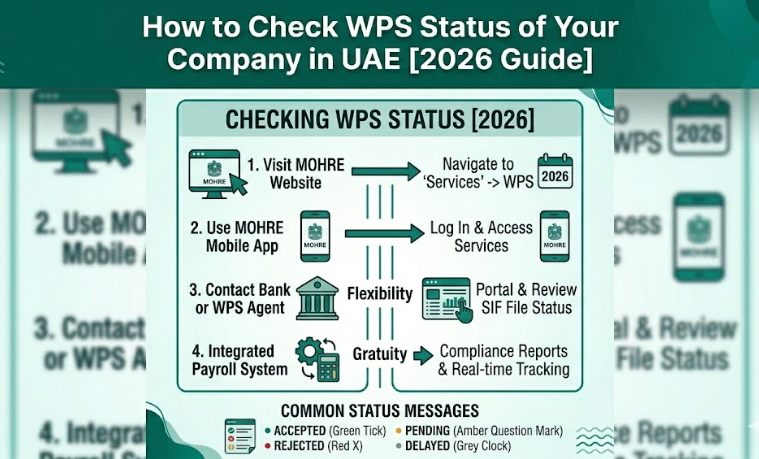
Businesses can check their WPS status through multiple official channels. The process is straightforward when payroll systems are properly structured.
1. Check via MOHRE Website
- Visit the official MOHRE website
- Navigate to “Services” and select “WPS”
- Enter company details such as Labour Establishment Number
- View the status of submitted salary files
This method provides a quick overview of whether payroll submissions are accepted, pending, or rejected.
2. Check via MOHRE Mobile App
The MOHRE mobile application allows employers to monitor payroll activity in real time.
Steps:
- Log in using company credentials
- Access WPS services
- Review salary transfer status and alerts
This is a convenient option for ongoing payroll monitoring.
3. Check Through Your Bank or WPS Agent
Authorized banks and exchange houses that process WPS payments provide status updates.
- Access the bank portal or payroll dashboard
- Review Salary Information File (SIF) submission status
- Check for any rejected or returned files
This method is commonly used by companies with integrated payroll systems.
4. Verify via Payroll or HR Systems
Many businesses rely on internal systems or external providers offering HR and payroll consulting services.
- Payroll software often includes WPS tracking dashboards
- Consultants can provide compliance reports and alerts
- Integration with accounting systems ensures accuracy
This approach reduces manual errors and improves efficiency.
Common WPS Status Messages Explained
When checking WPS status of company, understanding status messages is important:
- Accepted – Salary file processed successfully
- Rejected – Errors in SIF file (e.g., incorrect employee details)
- Pending – Under review by bank or MOHRE
- Delayed – Salaries not processed within required timeframe
Prompt action is required if any issues appear, especially rejections or delays.
Key Compliance Requirements Under WPS UAE Regulations
To remain compliant, companies must:
- Complete WPS registration with an approved bank or agent
- Pay salaries within the required timeframe (typically within 10 days of due date)
- Ensure accurate employee data in SIF files
- Maintain proper payroll documentation
Failure to comply with WPS UAE regulations may result in fines, suspension of work permits, or company classification downgrades.
Common Issues Affecting WPS Status
Several factors can impact WPS processing:
- Incorrect employee details in payroll files
- Mismatch between labour contracts and salary data
- Delayed salary processing
- Technical errors in SIF uploads
Regular monitoring and structured payroll processes help mitigate these risks.
Best Practices for Managing WPS Compliance
To maintain consistent compliance:
- Conduct routine checks on WPS status
- Align payroll processes with labour contracts
- Use automated payroll systems
- Engage HR and payroll consulting support when needed
- Maintain accurate records for audits
These practices are particularly relevant for businesses operating in WPS Dubai, where compliance monitoring is strictly enforced.
Conclusion
Understanding how to check WPS status of company operations is essential for maintaining payroll compliance in the UAE. Regular monitoring, accurate payroll processing, and adherence to WPS UAE regulations help businesses avoid penalties and ensure smooth operations.
Companies that invest in structured payroll systems and professional HR and payroll consulting support are better positioned to manage compliance efficiently and reduce operational risk.
How We Helps
We supports businesses in managing WPS compliance through structured payroll processes and accurate salary file submissions. Our team reviews WPS registration, validates SIF files, and monitors payroll transactions to ensure alignment with WPS UAE regulations.
Contact us today to optimise payroll operations, improve WPS tracking, and maintain compliance across UAE payroll requirements