
Managing payroll in the United Arab Emirates requires a clear understanding of payroll regulations and employment laws. Employers must ensure compliance with the UAE employment law and Dubai labor law to avoid penalties, protect employee rights, and maintain smooth business operations.
This article highlights key aspects of UAE payroll regulations and practical steps to implement compliant payroll processes.
Understanding UAE Payroll Regulations
Payroll regulations in the UAE govern how employers calculate, process, and disburse employee salaries. These rules ensure timely payment, statutory deductions, and adherence to labor laws. Employers are responsible for maintaining accurate payroll records, complying with minimum wage requirements, and handling end-of-service benefits correctly under the UAE termination law.
Compliance with these regulations is crucial, as failure to adhere can lead to fines, disputes, or legal complications. Organizations operating in Dubai must also follow the Dubai labor law, which includes specific requirements for working hours, leave entitlements, and termination procedures.
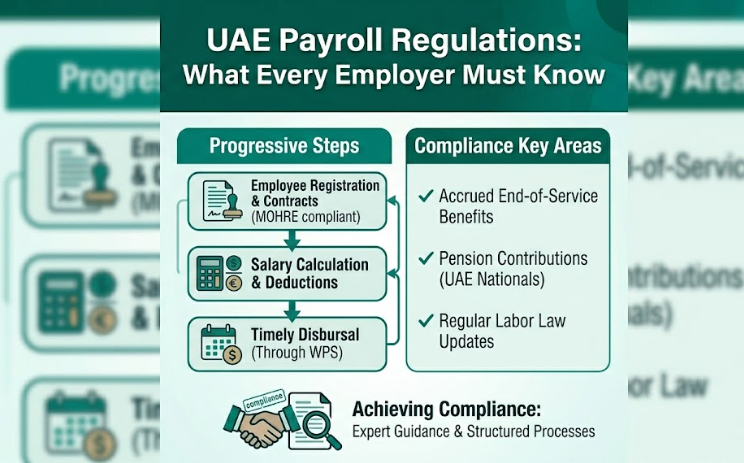
Key Payroll Process Steps in UAE
Implementing an efficient payroll system involves several critical steps:
- Employee Registration and Contracts
Ensure that all employees are registered with the Ministry of Human Resources and Emiratisation (MOHRE) and have contracts aligned with UAE employment law.
- Salary Calculation
Compute gross salaries, including allowances, overtime, and bonuses. Deduct applicable contributions and ensure compliance with statutory obligations.
- Deductions and Contributions
Employers must manage end-of-service gratuity, pension contributions for UAE nationals, and any other legally mandated deductions.
- Payment Disbursement
Salaries should be paid on time and preferably through approved banking channels, following the defined payroll process steps in UAE.
Importance of Professional Payroll Services in Dubai
Many businesses rely on specialized payroll services in Dubai to navigate complex labor laws and ensure compliance. Professional providers help organizations optimise salary processing, manage statutory filings, and reduce risks associated with payroll errors. These services also assist with handling employee terminations in accordance with UAE termination law, ensuring that end-of-service benefits are calculated and paid accurately.
Common Challenges in UAE Payroll Compliance
Employers often encounter challenges such as:
- Misinterpreting labor law requirements
- Incorrect calculation of gratuity and benefits
- Delays in salary disbursement
- Non-compliance with statutory reporting obligations
Addressing these challenges requires a thorough understanding of UAE employment law and expert guidance on payroll regulations.
How Employers Can Stay Compliant
To remain compliant, organizations should:
- Regularly review Dubai labor law updates
- Automate payroll processes to minimize errors
- Engage professional payroll services in Dubai for expert handling
- Train HR teams on legal obligations and best practices
By following these steps, employers can ensure smooth operations, protect employee rights, and reduce legal risks.
Conclusion
Adhering to payroll regulations in the UAE is essential for all employers. Understanding UAE employment law, following payroll process steps in UAE, and leveraging payroll services in Dubai help businesses remain compliant, avoid penalties, and maintain workforce satisfaction. Proactive management of payroll and termination procedures ensures legal compliance and operational efficiency across UAE organizations.
How We Helps
We assists businesses in managing UAE payroll regulations and optimising the payroll process steps in UAE. Our team ensures accurate salary calculations, oversees statutory deductions, and maintains full compliance with UAE employment law and Dubai labor law.
Contact us today to simplify payroll operations and remain fully compliant with UAE regulations.