
Understanding payroll vs bookkeeping is essential for businesses that require accurate financial records, reliable reporting, and regulatory compliance. Both functions support a company’s finances, yet they differ in purpose, timing, and regulatory obligations. Clear distinctions help managers assign responsibility, select the right services, and control costs.
This article outlines the key differences between payroll and bookkeeping and explains why the distinction matters for compliance and financial control.
What is Payroll?
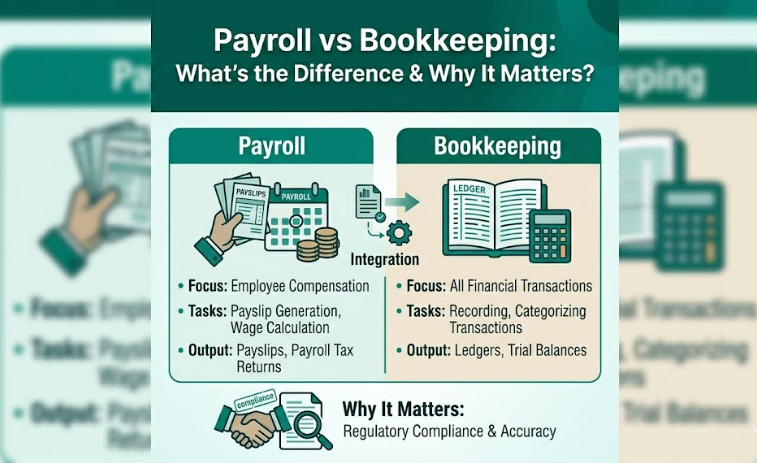
Payroll manages employee compensation. It includes gross pay calculations, deductions for taxes and benefits, net pay distribution, and employer contributions. Payroll activity produces payslips, payroll registers, and statutory returns. For many businesses, payroll also involves interaction with human resources systems, social security schemes, and local reporting platforms.
Because payroll directly affects employees, errors create immediate consequences: incorrect pay, disputes, and potential penalties. This link to labour law and tax rules explains why businesses often treat payroll as a specialised function rather than a routine bookkeeping task.
What is Bookkeeping?
Bookkeeping records and organises all financial transactions. Typical bookkeeping tasks include recording sales and purchases, coding invoices, reconciling bank statements, and maintaining ledgers. Bookkeeping provides the raw data that accounting uses to produce financial statements and tax returns.
Bookkeeping and payroll intersect when payroll entries are posted to the general ledger, but bookkeeping’s scope remains broader: it tracks cash flow, monitors liabilities such as accounts payable, and supports month-end close procedures.
Key Differences: Payroll vs Bookkeeping
| Dimension | Payroll | Bookkeeping |
| Primary focus | Employee compensation and statutory reporting | Recording all financial transactions |
| Frequency | Periodic (monthly, biweekly) | Continuous |
| Compliance drivers | Labour law, payroll tax, statutory filings | Tax law, accounting standards |
| Outputs | Payslips, payroll tax returns | Ledgers, trial balance, reconciliations |
| Typical risks | Wage errors, labour penalties | Misstated accounts, incorrect tax filings |
Recognising these differences clarifies why payroll often requires specialised software, dedicated staff, or external providers. It also explains why bookkeeping and payroll should be coordinated but not conflated.
How Payroll Relates to Accounting
Payroll and accounting work together to produce accurate financial statements. Payroll data feeds into accounting records as wage expenses, employer contributions, and payroll liabilities. Proper integration prevents mismatches between payroll registers and the general ledger.
When accounting closes month end, reconciliations must confirm that payroll entries balance to cash movements and statutory liabilities. This integration reduces audit risk and improves financial visibility.
Payroll vs Accounts Payable
Understanding the difference between payroll vs accounts payable is crucial for accurate financial control. Payroll handles employee compensation, including wages, taxes, and benefits, while accounts payable focuses on processing payments to suppliers and vendors. Both functions involve cash outflows but follow different approval workflows and statutory requirements. Keeping payroll vs accounts payable separate strengthens internal controls and reduces the risk of errors or fraud.
Outsourcing Payroll and Bookkeeping: When It Makes Sense
Many organisations compare the costs and risks of in-house payroll against external options. Payroll outsourcing companies in Dubai and elsewhere offer specialist knowledge of local regulations, faster statutory reporting, and reduced administrative burden. Outsourcing suits organisations that require consistent compliance, scalable processing, or integrated payroll and HR support.
When selecting providers, businesses should evaluate:
- Experience with local labour and tax rules
- Integration capabilities with accounting systems
- Security and data protection measures
- Service levels for payroll and bookkeeping services
Choosing Payroll and Bookkeeping Services
Selecting services depends on business size, transaction volume, and regulatory complexity. Small businesses may combine bookkeeping and payroll in a single package, while larger firms often separate duties to improve control and accuracy. Clear contracts should define deliverables, timelines, and responsibility for statutory filings.
For organisations expanding into new jurisdictions, partnering with local payroll outsourcing companies in Dubai can accelerate market entry and reduce compliance risk.
Conclusion
Distinguishing payroll vs bookkeeping enables better financial management. Payroll focuses on employee compensation and statutory compliance; bookkeeping records the financial life of the business. Both are essential, and their correct interaction produces reliable reporting, lowers compliance risk, and supports strategic decision-making.
How We Helps
We provides payroll and bookkeeping services that align payroll processing with accounting records. Our team supports statutory filings, WPS compliance, and integration with existing ledgers, allowing organisations to focus on operations while maintaining accurate financial control.
Contact us today to simplify payroll operations and maintain compliance with UAE regulations.