
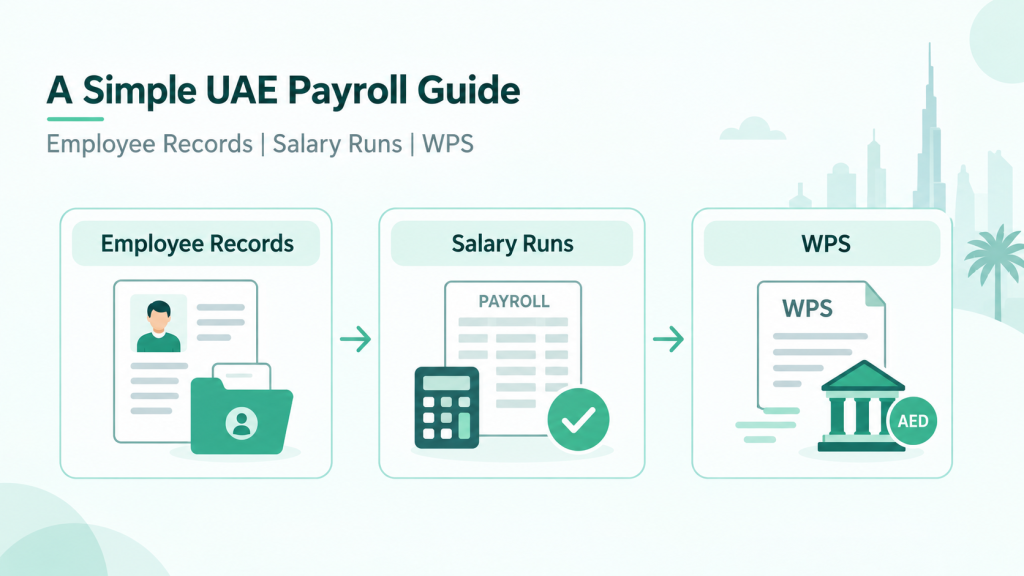
A reliable UAE payroll process depends on accurate employee records, correct salary calculations and wage information that matches the final payroll run. For businesses covered by the Wages Protection System (WPS), errors in payroll data can also affect salary processing and payment records.
This article outlines how salary runs work, where WPS fits into the payroll cycle and what employee records support accurate monthly payroll.
How a UAE Salary Run Works
A salary run is the process of calculating employee wages for a specific payroll period.
It normally starts with changes recorded since the previous month. These may include new joiners, leavers, salary revisions, unpaid leave, overtime, variable pay, allowances and authorised deductions.
The payroll team uses these approved inputs to determine what each employee should receive. The figures are then reviewed before payment.
A typical UAE payroll process moves through five stages:
- Update employee information: Record approved employment, salary and leave changes.
- Calculate salaries: Apply basic salary, allowances, variable payments and authorised deductions.
- Review the payroll: Compare calculated amounts with approved inputs and investigate unusual changes.
- Process payment: Submit approved wage information through the applicable WPS or payment channel.
- Reconcile the run: Confirm that processed amounts match the approved payroll and resolve rejected or corrected payments.
Accurate employee data is the starting point for reliable UAE payroll, because every later calculation depends on the information recorded before the salary run.
This provides a practical framework for businesses reviewing how to process payroll in the UAE without adding unnecessary steps to the monthly cycle.
Where WPS Fits Into the Salary Run
The Wages Protection System is the UAE’s electronic wage-payment framework. It allows salary payments to be processed through approved channels and enables the relevant authorities to monitor wage payments.
For establishments registered with MoHRE, wages must be paid on their due dates through WPS or another system approved by the Ministry, in accordance with the applicable wage-payment requirements. Current MoHRE legislation links wage payment to the due date agreed in the employment contract and the applicable Ministry rules.
Understanding how WPS works in the UAE is easier when it is treated as the payment stage of the payroll cycle rather than the complete payroll process.
The employer first establishes what each employee should receive. Those amounts are reviewed and approved before the wage information is submitted for payment.
A Salary Information File (SIF) may form part of WPS processing. It contains the wage information used to process employee salary payments through the applicable system.
For salary processing in the UAE, the distinction is important. WPS processes wage-payment information, but it does not calculate an employee’s salary. If the payroll data is incorrect before submission, the payment information can also be incorrect.
What Employee Records Support Payroll?
Accurate employee payroll records provide the information behind each salary calculation.
Relevant records may include:
- Employment contract and agreed salary
- Basic salary and allowances
- Approved salary amendments
- Attendance information where relevant
- Approved unpaid leave
- Overtime or variable pay where applicable
- Authorised deductions
- Employee payment details
- Previous payroll and payment records
- Information relating to new joiners or leavers
These records help explain why an employee’s salary may change from one month to the next.
For example, incorrectly recorded unpaid leave can affect the salary calculation. A missing salary amendment can result in an outdated amount being used. Incorrect payment details can cause a payment issue even when the salary itself has been calculated correctly.
UAE employment law also requires employers within its scope to maintain employee files and records in accordance with the applicable requirements.
This does not mean that every internal payroll document is separately prescribed by law. Some documents support day-to-day payroll administration, internal review and evidence of how a salary was calculated.
Maintaining current employee payroll records therefore supports salary accuracy and provides a clearer record of the information used for each payroll run.
A Simple Monthly Payroll Checklist
A practical monthly payroll process for UAE businesses can focus on a small number of checks before, during and after payment.
Before the Salary Run
Confirm whether the month includes approved changes involving:
- New employees
- Employees leaving the business
- Salary amendments
- Allowances
- Overtime or variable pay
- Unpaid leave
- Authorised deductions
- Employee payment details
An internal payroll cut-off can give the payroll team enough time to collect and confirm these changes. This is an internal control rather than a general statutory requirement.
During the Salary Run
Review the calculated payroll against the approved employee changes for the month. Investigate material differences before the run moves to approval.
A significant increase or decrease may be valid, but it should correspond with an approved change such as overtime, unpaid leave, a salary revision or a final settlement.
When Processing WPS
Use the final approved payroll figures when preparing wage-payment information.
Where a SIF is required, it should reflect the approved salary run.
Accurate wage information also supports payroll compliance in the UAE, because the payment submitted should agree with the salary amounts already reviewed by the business.
After Payment
Confirm that the salaries processed match the approved payroll totals.
Rejected, returned or corrected payments should be identified and resolved. Relevant payroll records should then be retained with their supporting information.
This completes the monthly sequence:
Records → calculation → review → payment → reconciliation
Keeping this sequence clear makes it easier to identify where an error occurred and what needs to be corrected before the next salary run.
Conclusion
A reliable UAE payroll cycle depends on accurate employee records, correct salary calculations and wage information that matches the approved payroll run. WPS is an important part of the payment stage, but its accuracy depends on the information prepared beforehand. Keeping employee data current, reviewing payroll changes and reconciling completed payments can make the UAE payroll process more accurate and easier to manage each month.
How SimplySolved Helps
SimplySolved supports UAE businesses with payroll administration, salary processing in the UAE, WPS and SIF support, employee payroll records and payroll reporting. The team can manage recurring salary runs, review payroll inputs and support businesses that need structured or outsourced HR and payroll services.
Get in touch with us today to review payroll accuracy, WPS readiness and monthly salary processing before the next payroll cycle.