
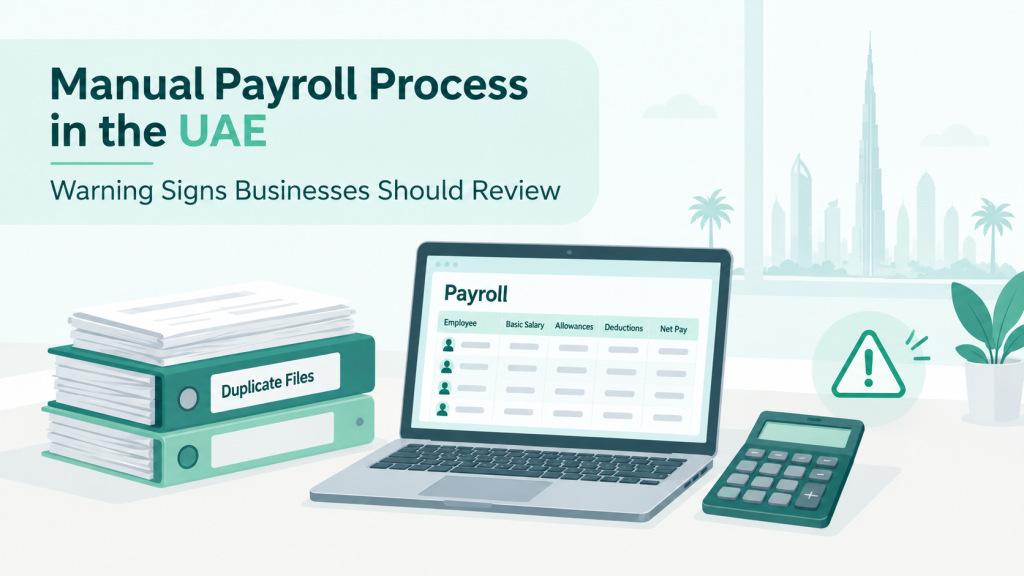
A manual payroll process in the UAE may be manageable for a small business with a limited workforce and few monthly changes. As employee numbers increase, however, repeated data entry, spreadsheet-based calculations and disconnected records can make payroll harder to control.
The issue is not manual work itself. It is whether the process has become too dependent on repeated checks, individual knowledge and separate files. The following warning signs can help UAE businesses identify when their payroll process may have outgrown its current method.
When Does a Manual Payroll Process Become a Problem?
Some manual payroll activities are normal. HR or finance teams may review attendance, confirm allowances or approve salary adjustments manually without creating operational problems.
A manual payroll process in the UAE becomes a concern when manual intervention is repetitive, difficult to review, dependent on one person or increasingly time-consuming. At that point, the process becomes harder to manage as payroll requirements increase.
Signs a UAE Payroll Process Is Too Manual
1. The Same Payroll Data Is Entered More Than Once
Repeated data entry is one of the clearest warning signs.
Attendance, leave, overtime, allowances or deductions may first be recorded by HR and then entered again into payroll spreadsheets. Salary revisions may require another manual update.
This duplication increases administrative work and creates more opportunities for inconsistent information to enter payroll processing.
2. The Payroll Cycle Keeps Taking Longer
Payroll processing time should not increase disproportionately every time headcount grows.
A process that worked for 10 employees may become difficult to manage with 50 or 100 when each new joiner, salary adjustment, leave change or final settlement requires separate manual handling.
If payroll processing regularly takes longer despite similar procedures, the current UAE payroll process may no longer scale with the business.
3. Payroll Depends on One Person
A payroll process becomes vulnerable when most of its knowledge sits with one employee.
That person may understand spreadsheet formulas, salary adjustments, exceptions and month-end procedures better than anyone else. If the employee is unavailable, another team member may struggle to complete payroll correctly or on time.
This creates a continuity risk. Payroll procedures and responsibilities should be clear enough for the process to continue without relying on one individual.
4. Payroll Corrections Are Becoming Routine
Occasional corrections can occur in any payroll function. Frequent preventable corrections point to a different problem.
Examples may include missed allowances, outdated salary information, incorrect deductions, unrecorded leave changes or reconciliation differences.
Recurring payroll errors can indicate weak input or review controls. If the same corrections appear regularly, the business should examine where payroll information enters the process and how it is checked before salaries are finalised.
5. There Is No Single Source of Employee Data
Payroll becomes harder to validate when salary, bank, leave and attendance information sits in different files or systems.
Payroll staff may need to compare several records before confirming which information is current. This becomes more difficult when employee details change frequently.
A fragmented data structure can create uncertainty even when individual records are accurate. Centralised employee information can reduce the need to repeatedly verify different versions and strengthen the underlying payroll system.
6. WPS or SIF Preparation Requires Rebuilding Payroll Data
For employers subject to the Wage Protection System, payroll information must support the applicable salary-payment process. Where Salary Information File preparation requires staff to rebuild or manually compare salary information from several records every month, it creates another manual control point.
In that situation, the issue is usually not WPS itself. It is that the underlying manual payroll process in the UAE does not produce payroll data in a consistent form.
7. Payroll Approvals Are Difficult to Trace
Payroll approvals become difficult to control when they are spread across emails, messages, verbal instructions and different spreadsheet versions.
Staff may struggle to confirm who approved a salary change, which payroll file was reviewed or whether the final version reflects the authorised adjustments.
This creates an accountability gap. A clear approval trail should show who prepared, reviewed and approved payroll without requiring staff to search across several communication channels.
8. Payroll Reporting Has to Be Rebuilt After Processing
A further warning sign appears when payroll is complete but finance teams still need to recreate the information for reporting.
Separate spreadsheets may be required to prepare payroll journals, reconcile salary costs or analyse employee expenses.
If the same payroll data has to be rebuilt after salaries are processed, the output may not be structured enough to support payroll reconciliation and management reporting efficiently.
What Should Businesses Review?
If several of these warning signs appear together, the business should review how employee data enters payroll, where calculations are performed, how adjustments are approved and how payroll information is reconciled.
The appropriate response depends on the weaknesses identified in the existing payroll system and payroll processing controls. Stronger controls, better system support or payroll automation in the UAE may reduce repeated manual work. Outsourced payroll support may also be relevant where internal resources cannot manage increasing payroll requirements effectively.
The objective should be to address the specific areas creating unnecessary manual dependency rather than replace every manual task.
Conclusion
A manual payroll process in the UAE becomes difficult to maintain when repeated data entry, recurring corrections, fragmented employee records, unclear approvals and increasing processing time become part of each payroll cycle.
These warning signs show where stronger payroll controls or better system support may be required. Reviewing them early can help businesses prevent payroll administration from becoming harder to manage as operational requirements increase.
How SimplySolved Helps
SimplySolved supports UAE businesses with payroll process assessments, monthly payroll processing, employee-record management, WPS and SIF support where applicable, payroll reporting, payroll systems and workflow automation.
Contact us today to assess whether your current payroll process requires stronger controls, greater automation or outsourced payroll support.